


Electronics
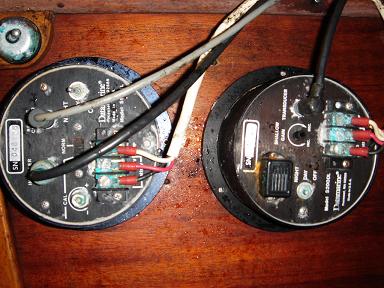
December 2008. Not much.
Here is a picture of the original Datamarine sailing instruments with corroded terminals due to some salty spray from the cockpit and no cover.
There has been an old non-functioning disconnected Loran autopilot in the cockpit, which will be replaced with a Raymarine SPX 5 Plus tiller one.
Inside the cabin, there is a working barometer.
There is a VHF cable but no VHF radio.
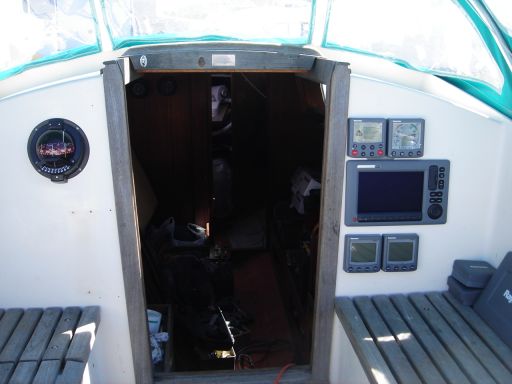
April 2009. New electronics
I decided to go with wind, speed and depth indicators because it was cheaper to buy them all in one pack. I got Raymarine ST-60 series instruments. The speed instrument gives also a water temperature. Alternatively, I could just acquire transducers and connect them to the multifunctional display C90W but that would leave me without the wind indicator and I would need to go with a digital sounding module for the depth transducer, a la fishfinder. In my future log book I don't want to lie about the wind speed. With the wind instrument it is also possible to steer a boat with an autopilot to a certain degree to the apparent wind rather than by a compass.
Speaking of a compass, I had to get a new one because the original was mounted on a pedestal and could not be adopted for the bulkhead with my move back to the tiller steering. Richie makes a beautiful large bulkhead mount compass with a heel level indicator, clinometer.
Besides other emergency equipment such as sea anchor and drogue, I bought 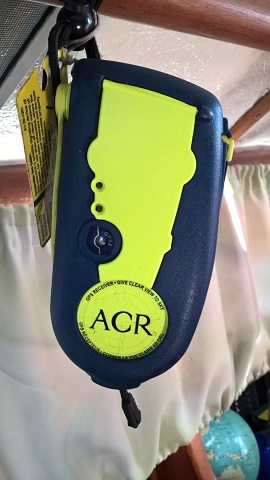 ACR EPIRB.
March 2011. AIS transponder
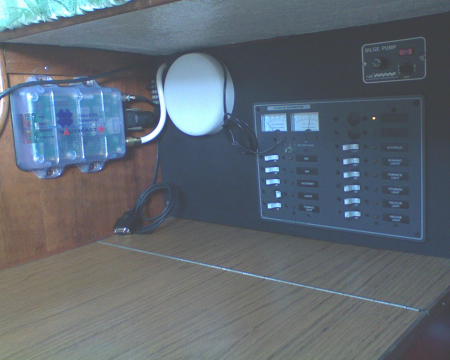
Finally, I installed what I had planned from the beginning - AIS transponder. This is an ACR Electronics Nauticast "B" AIS Transponder. Compared to other models on the market, it made to meet all the requirements of the class "B" AIS devices, i.e. it has separate VHF and GPS antennas and built-in GPS receiver. In other words, it is completely autonomous system and does not depend on any other boat's electronics. I connected it to my VHF antenna on the mast since it is not used anyway. I still have only the hand-held VHF. And I mounted the GPS antenna on a 1-inch SS tube attached to the stanchion. I connected the transponder to the Raymarine chartplotter via an RS422 interface and powered it from the same circuit as the chartplotter but provided its own 3A breaker. The AIS consumes on average 4 watts and the pick current is 2 A.
It works great! I was able to pick up targets up to 20 miles away from me. I can setup a safety zone and the Raymarine will alert me with an annoying beeping when there are any targets in my safety zone. Now I can sleep hopefully for more than 15 minutes at night.
Later I had to stop using the VHF antenna on the mast because the tri-color light created strong interference with AIS causing it to display errors on the Raymarine display and annoying beeping at night with a flashing red light. In other words, it was not possible to sleep well. I mounted the AIS VHF antenna on the same pole where my solar panel was.
February 2013. Stationary VHF radio
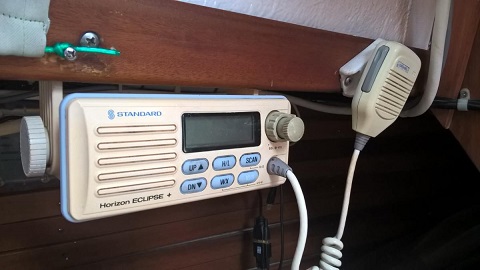
During my last Dominican Republic cruise, when I went to Santo Domingo and left Beruta on
a mooring buoy in marina Zar Par in Boca Chica, in a day time someone broke into my boat and stole among other things my hand-held VHF radio. I was left without an important communication device. Thank Leonid who gave away his, which I actually connected to the VHF antenna on the mast. I wonder though if tri-color will keep interfering with my radio as well.
I found for example that when 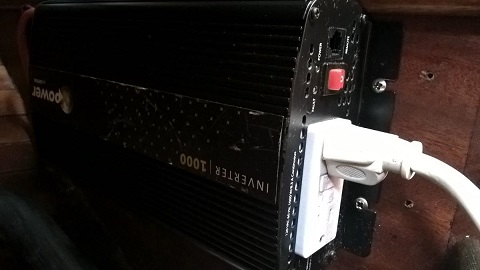 Xantrex inverter that is installed 1 meter below
the radio, is on, it creates so much noise that it is impossible to hear anything that I say.
Xantrex inverter that is installed 1 meter below
the radio, is on, it creates so much noise that it is impossible to hear anything that I say.
April 2015. Raytheon radar
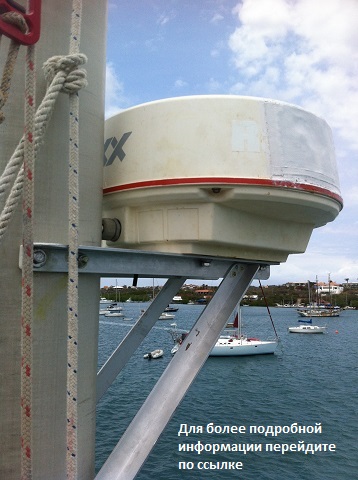
My friend gave me his old Raytheon radar. His new windgenerator accidentally broke its cover. So I epoxied 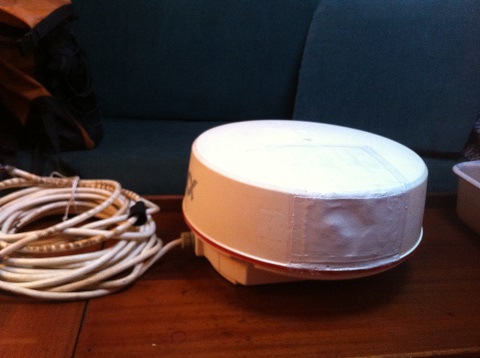 the cover and painted it, then made
 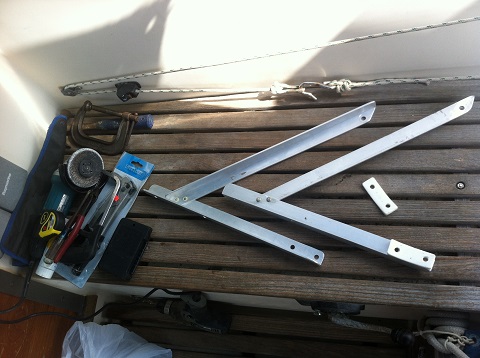 aluminum brackets and bolted them through the mast. I mounted
 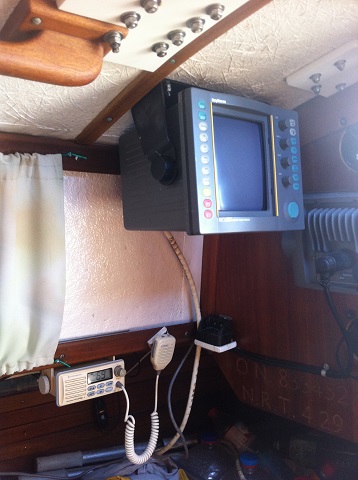 the raster display in the cabin close to other instruments. On the electrical panel I installed a separate 10-amp breaker. The most difficult part was to pull the heavy cable through the mast from the top down (I had to climb the mast 5 times that day) and then solder the 16-pin plug. Oh, well, it was done!
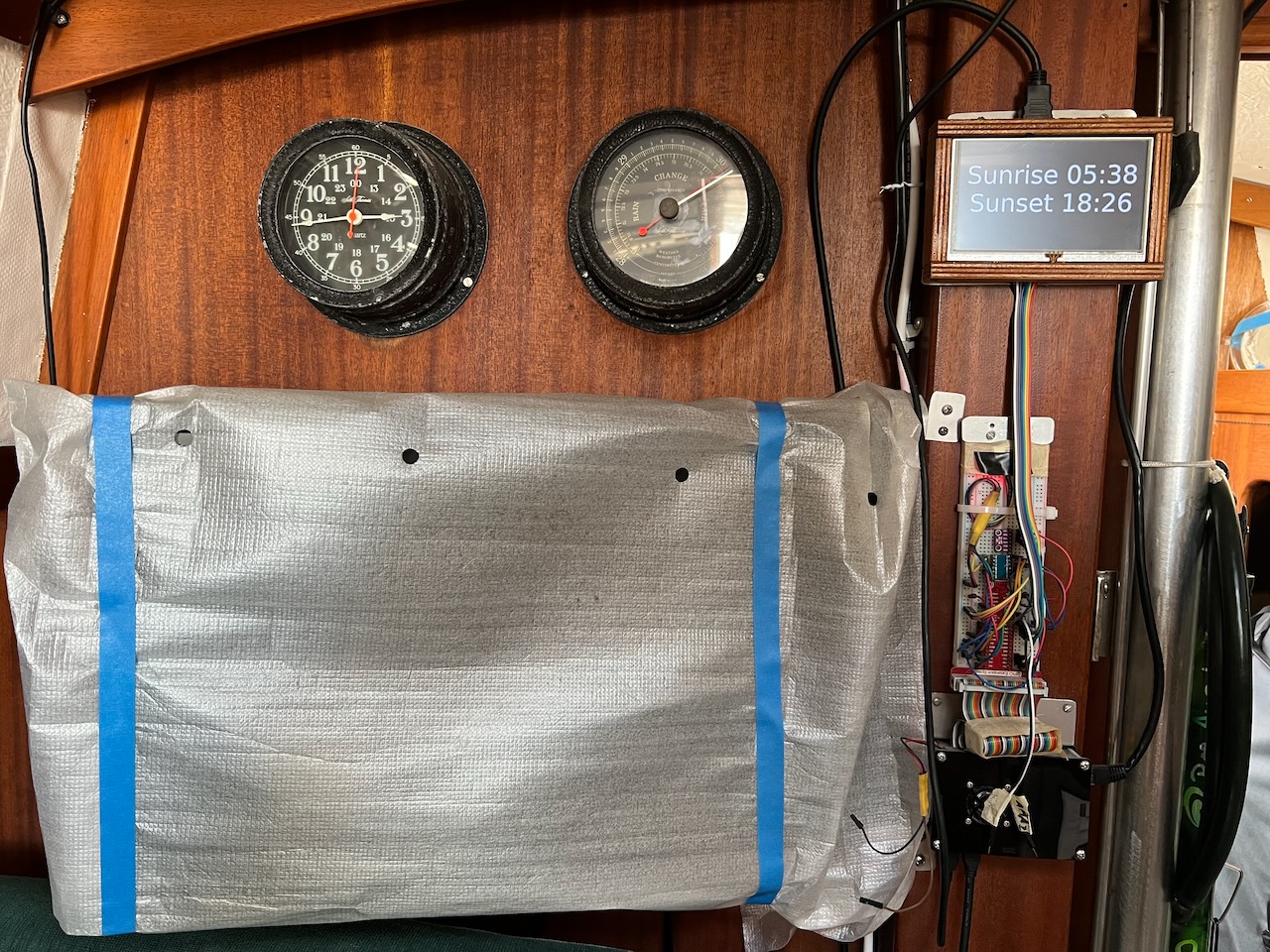
2020. Raspberry Pies
Sometime in New Zealand I bought RP-3, then RP-4. The idea was to use them for a boat automation, same as for the home automation. Initially, they were used as environmental sensors such as temperature, humidity and atmospheric pressure. Later I added an air quality sensor. Then after I made a ventilation system of an engine compartment, I used RP to automatically turn on and off the fan based on a schedule in linux crontab via Wi-Fi enabled relay (ESP-01s). See my github pages for details. Even later, I adopted the same relays to control a cabin ventilation system and a dehumidifier using environmental sensors.
I also wanted to use RPs as a primary or a backup navigation system. They have GPS modules, and also are fed data from my existing navigation equipment such as a chartplotter via an NMEA-to-USB converter and an AIS transceiver via a serial-to-USB converter. Later I added an integration with weather models for a possible weather routing. My PHP scripts use some libraries to parse GRIB files and extract data from them. The scripts also interact with gpsd daemon that aggregates information obtained from the GPS and AIS feeds. The voyage data is saved in a database including track points. Later a track can be exported in a GPX format, and all other data can be graphed. One of the scripts can be used as a collision prevention system. It plots a collision graph and prints valuable data such as time and distance to the intersection of courses. Various alarms are built-in including a shallow depth, off course degrees, max xtd, a collision scenario, etc, etc.
The RP-4 has a small LCD connected to it and attached to the mast bulkhead in the cabin. It is used to display all the necessary navigation data such as SOG, COG, XTD, depth, wind, pressure graphs, necessary correction for the course, statistics such as a daily milage, ETA to a next waypoint, etc, etc (see my ship's log for more info). I update and improve my navigation system all the time.
The large LCD can also be connected to RP-4 via HDMI to display OpenCPN charts, for example.
August 2023. Darwin, Australia. Raymarine C90w new display
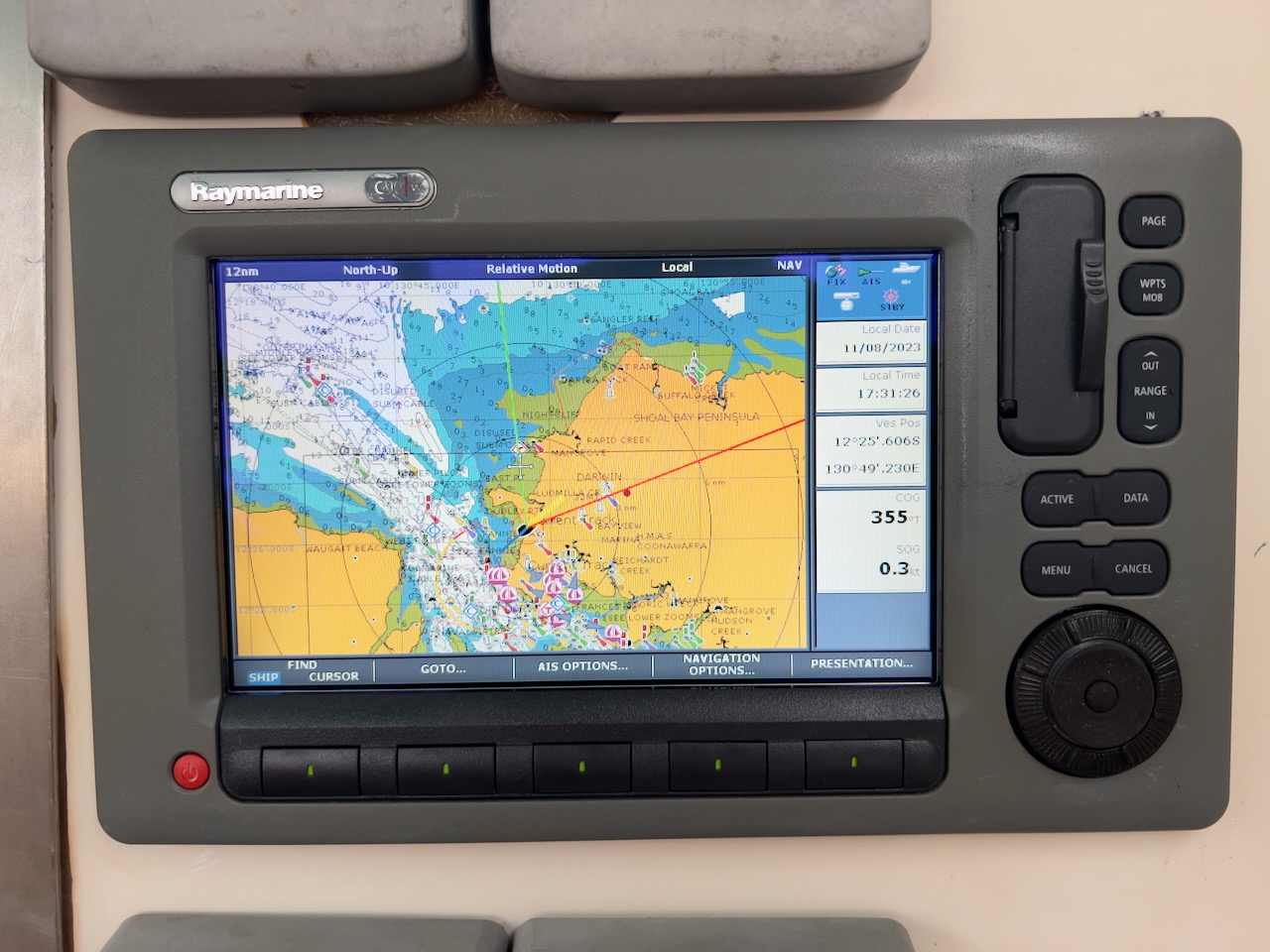
Raymarine C90w multifunctional display, aka chartplotter, did not survive New Zealand winters with their cold nights and hence, condensation. The moisture got in between LCD films, and a picture became blurry and practically invisible during a day light.
I found the same used chartplotter with a good LCD and a new joystick button online and ordered it. It happened to have one of COM ports broken. I was mostly interested in getting anemometer and depth sounder data from it. The rest I could get from gpsd daemon. Therefore, I had to swap the CPU units, which also kept all my tracks.